

How to Automate Lead Qualification: The Complete System for B2B Founders Who Can’t Afford to Lose Another Hot Lead
You’re losing qualified leads every single day, and you don’t even know it. While you’re in meetings, sleeping, or handling client work, potential buyers are visiting your site, filling out forms, and getting zero immediate response. By the time your team follows up 24-48 hours later, they’ve already talked to three competitors. That’s not a sales problem—that’s a systems problem.
Manual lead qualification doesn’t just waste time; it actively hemorrhages revenue. Your sales team spends 67% of their day on administrative tasks instead of selling, your marketing can’t tell which leads are worth nurturing, and high-intent prospects slip through the cracks because nobody scored them correctly. The solution isn’t hiring more SDRs or working longer hours—it’s building an automated lead qualification system that works while you sleep.
Why Manual Lead Qualification Is Bleeding Your Business Dry
Every hour your team spends manually researching leads, updating spreadsheets, and deciding who’s “sales-ready” is an hour they’re not closing deals. Here’s what manual qualification actually costs you:
- Delayed response times: Hot leads cool off within 5 minutes; your team responds in 24+ hours
- Inconsistent scoring: Different reps use different criteria, so qualification quality varies wildly
- Wasted sales cycles: Reps spend hours on unqualified leads that were never going to convert
- Lost data insights: No systematic tracking means you can’t identify patterns or optimize your funnel
- Zero scalability: More leads = more chaos, not more revenue
The companies dominating your market right now aren’t smarter than you—they just automated this process months ago. While you’re manually Googling company names and checking LinkedIn profiles, their AI systems are scoring leads in real-time, routing SQLs to sales instantly, and nurturing MQLs automatically.
The Automated Lead Qualification System: Architecture & Strategy:
| System Component | Function | Business Impact |
|---|---|---|
| Lead Capture Integration | Forms, chatbots, LinkedIn, web tracking | Captures 100% of inbound signals, zero manual data entry |
| AI Scoring Engine | Real-time qualification using ICP criteria | Prioritizes high-value leads instantly, eliminates guesswork |
| CRM Enrichment | Auto-fills company data, tech stack, intent signals | Reps see full context before first call, no research time |
| Smart Routing | SQLs → Sales; MQLs → Nurture; Cold → Monitoring | Right leads reach right people at right time, zero delays |
| Automated Follow-Up | Triggers emails, tasks, notifications based on score | Engagement happens instantly, not days later |
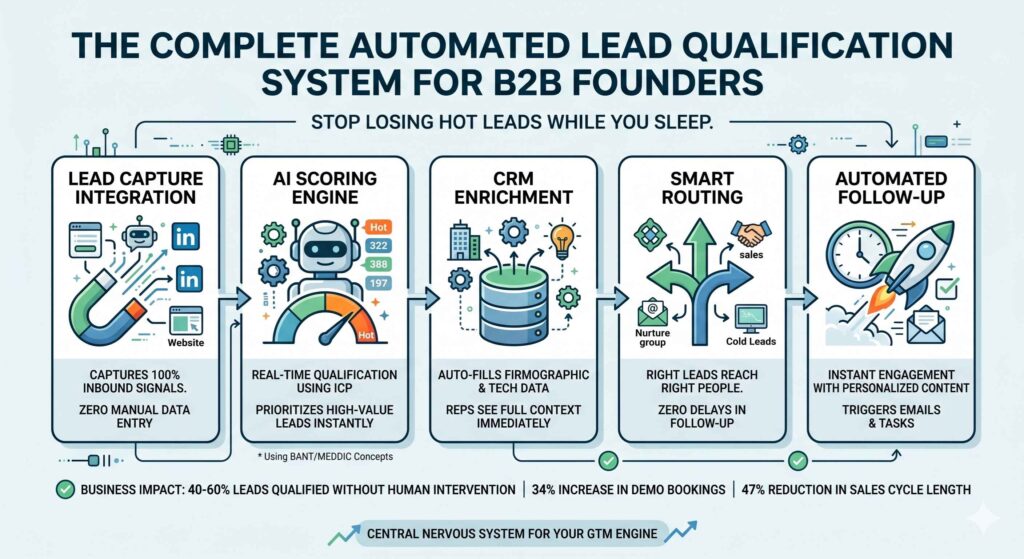
An effective automated lead qualification system has five layers that work together seamlessly. First, your lead capture layer collects signals from every channel—website forms, chatbot conversations, LinkedIn outreach, email engagement, and behavioral tracking. Second, your scoring engine applies your ICP criteria in real-time: company size, industry, role, budget signals, engagement level, and intent data. Third, enrichment tools automatically pull firmographic data, technographic data, and buying signals without manual research.
Fourth, your routing logic sends SQL-tier leads directly to sales with full context, triggers nurture sequences for MQLs, and tags low-scoring leads for monitoring. Fifth, your follow-up automation ensures every qualified lead gets immediate engagement—whether that’s a personalized email, a calendar link, or a notification to your sales team. This isn’t theory—B2B companies running this system report 40-60% of leads qualified without human intervention.
System Components Overview
Lead Capture Integration – Captures 100% of inbound signals through forms, chatbots, LinkedIn, and web tracking with zero manual data entry.
AI Scoring Engine – Prioritizes high-value leads instantly using real-time qualification against your ICP criteria, eliminating guesswork.
CRM Enrichment – Auto-fills company data, tech stack, and intent signals so reps see full context before the first call with no research time needed.
Smart Routing – Sends SQLs to sales, MQLs to nurture sequences, and cold leads to monitoring ensuring the right leads reach the right people at the right time with zero delays.
Automated Follow-Up – Triggers emails, tasks, and notifications based on lead score so engagement happens instantly, not days later.
Building Your Lead Qualification Automation: The Step-by-Step System
Step 1: Define your ICP with measurable precision
Stop using vague criteria like “decision-makers at mid-sized companies.” Your ICP needs hard data points your system can score automatically: annual revenue range, employee count, specific industries or verticals, tech stack indicators, and job titles with buying authority. If your ideal client is a real estate brokerage with 10-50 agents looking to automate follow-ups, your system should automatically flag leads matching those exact parameters.
Step 2: Choose your automation stack and integrate it properly
Your CRM is the foundation—HubSpot, Salesforce, or Pipedrive depending on your budget. Layer on AI scoring tools like Clearbit, ZoomInfo, or AI-native platforms for enrichment and predictive scoring. Add chatbot qualification through Drift, Intercom, or custom AI agents for real-time conversation-based scoring. Connect everything via API or native integrations so data flows automatically—no manual exports or CSV uploads.
Step 3: Build your scoring model using frameworks that match your sales cycle
BANT (Budget, Authority, Need, Timeline) works for transactional sales; MEDDIC (Metrics, Economic Buyer, Decision Criteria, Decision Process, Identify Pain, Champion) fits complex enterprise deals. Assign point values to each criterion: +20 points for C-suite title, +15 for company size match, +10 for recent content downloads, +25 for demo request. Set thresholds—80+ points equals SQL with immediate sales routing, 50-79 equals MQL for nurture sequences, below 50 gets monitored and retargeted.
Step 4: Set up automated routing and follow-up workflows
When a lead hits SQL threshold, trigger instant actions: Slack notification to sales, task created in CRM, personalized email with calendar link, lead data enriched with latest intent signals. For MQLs, enroll in multi-touch nurture sequence with case studies, ROI calculators, and educational content tailored to their pain points. For low-scoring leads, add to retargeting audiences and monthly newsletter list—they’re not ready now, but you stay top-of-mind.
Step 5: Monitor, test, and refine your system continuously
Track conversion rates by score tier, measure response times from qualification to first touch, analyze which criteria correlate strongest with closed deals, and audit your system monthly for drift or inaccuracies. The best systems evolve based on real performance data—if leads with “requested pricing” convert 3x better than “downloaded whitepaper,” adjust your scoring weights accordingly.
Real-World Implementation: What This Looks Like in Action
A B2B SaaS founder implemented this exact system and went from manually qualifying 20 leads per week to automatically processing 200+. Their chatbot asks three qualifying questions (company size, current process, timeline), their AI scores responses in real-time, and hot leads get routed to sales with full context within 90 seconds. Result: 34% increase in demo bookings, 47% reduction in sales cycle length, zero increase in headcount.
Real estate teams using automated qualification see similar results. Leads from Zillow, Realtor.com, and Facebook ads flow into their CRM, get scored based on price range and buying timeline, then receive instant personalized follow-up via email and SMS. High-intent buyers searching $500K+ properties who requested showing within 7 days trigger immediate agent notification. Lower-intent leads get drip campaigns with market updates and new listings. The system handles 80% of initial qualification, freeing agents to focus on showings and negotiations.
Medical aesthetics clinics face a different challenge: high-value treatment plans requiring multiple sessions and persistent follow-up. Automated qualification solves this by scoring leads on treatment interest (Botox vs. full facial rejuvenation plan), budget signals (insurance vs. cash pay), and engagement level. High-score leads get immediate consultation booking links and personalized treatment plan PDFs. The system also triggers re-engagement sequences for dropped treatment courses, recovering 25-40% of revenue that would otherwise disappear.
Why Most Lead Qualification Automation Projects Fail (And How to Avoid It)
The number one reason automation fails is building the system before defining the strategy. Teams rush to “set up HubSpot workflows” without clear ICP criteria, scoring logic, or success metrics. Six months later, they have a complex system that routes everything to sales regardless of fit, or scores every form-fill as “hot” because the thresholds are wrong.
The second killer is treating automation as “set and forget.” Your ICP shifts as your product evolves, market conditions change buyer behavior, and competitors alter their messaging. If you’re not reviewing conversion data monthly and adjusting your scoring model, your system degrades into noise. Third, most teams underestimate integration complexity—connecting five tools via Zapier duct tape creates fragile workflows that break constantly and require manual babysitting.
Successful implementations start with clean data and clear criteria, use native integrations wherever possible, involve both sales and marketing in defining scoring rules (not just one team guessing), and include weekly performance reviews for the first 90 days. The goal isn’t perfect automation on day one—it’s a functional system that improves every week based on real conversion data.
The Economics: What Automated Lead Qualification Actually Costs
Basic lead qualification automation starts at $0-50/month using free CRM tiers, native forms, and simple scoring rules. Mid-tier systems with AI enrichment, chatbot qualification, and multi-channel routing run $300-1,200/month depending on lead volume. Enterprise-grade platforms with predictive scoring, intent data, and advanced analytics start around $3,500/month with annual contracts.
But here’s the real math: If manual qualification costs your sales team 15 hours per week at $75/hour loaded cost, that’s $58,500 annually. If delayed response times cost you just 2 deals per month at $5K average contract value, that’s another $120,000 in lost revenue. A $500/month automation system that recovers even 25% of that lost revenue pays for itself 60x over. The question isn’t whether you can afford automation—it’s whether you can afford NOT to automate.
For real estate agents juggling 30+ active leads, automation priced at $100-300/month eliminates the need for a $3,000/month virtual assistant. For clinics with $8K average treatment plan values, a system that improves consultation booking rates by just 10% generates $96K+ in additional annual revenue. The ROI isn’t marginal—it’s exponential when you factor in speed, consistency, and scalability.
How This Integrates With Your Broader Revenue System
Automated lead qualification isn’t a standalone tactic—it’s the central nervous system of your entire go-to-market engine. It feeds data to your marketing team (which campaigns generate best-fit leads?), your sales team (who should I call first today?), your product team (what pain points are prospects mentioning most?), and your finance team (what’s our actual pipeline value by source?).
For service-based businesses like real estate brokerages, this connects to listing automation, showing scheduling, and post-sale referral systems. For clinics, it integrates with appointment booking, treatment reminders, and upsell sequences for complementary procedures. For B2B consultancies, it links to proposal automation, onboarding workflows, and client success platforms. When your qualification system talks to every other system, you eliminate data silos and create compounding efficiency gains.
The most sophisticated implementations use qualification data to optimize ad spend in real-time. If LinkedIn ads are generating 3x more SQLs than Google Ads at half the cost per lead, your system automatically shifts budget. If chatbot-qualified leads convert 2x better than form-fills, you prioritize chatbot-first experiences. This is the difference between automation that saves time and automation that multiplies revenue.
