

AI Automation Systems for B2B Founders: The 5‑Phase Playbook to Scale Without More Staff
If you are a B2B founder who feels like the business grows only when you grind harder, your real problem is not leads, it is systems.
Right now, you probably have pockets of automation, a couple of Zapier zaps, maybe an SDR sending cold emails, and a CRM that only gets updated when someone has time; meanwhile, AI automation agencies are quietly building end‑to‑end systems that turn lead‑to‑cash into a repeatable machine for their clients.
This blog gives you a practical, founder‑friendly blueprint for “AI automation systems for B2B” that focuses on one outcome: more revenue and profit without adding headcount every quarter.
Why Most B2B Founders Bleed Profit Before They Ever “Scale”
The hidden cost of manual workflows
Most B2B operators underestimate how much money dies inside manual workflows.
Every time a lead sits untouched in a CRM, a founder manually qualifies inbound inquiries, or your team copy‑pastes data between tools, you are burning paid ad spend, opportunity, and morale.
Research across B2B sectors shows that when you automate high‑volume, repetitive workflows like accounts payable, lead routing, or client onboarding, payback often happens in under 6–12 months and compound ROI over two years can easily exceed 200–300 percent.
The story is the same whether you are SaaS, agency, consulting, or services: the longer you stay in spreadsheet and “manual update” mode, the more you cap your growth at your personal energy level.
Why “more headcount” is the most expensive band‑aid
When growth finally hits, the default move is to hire: another SDR, another account manager, another operations assistant.
The problem is that humans added into broken systems just create more coordination overhead, more meetings, and more error, instead of more output.
Modern AI‑driven automation agencies are proving that one properly designed agentic system (for example, an AI‑assisted lead qualification and routing agent) can replace the work of multiple junior hires without the management drag.
The leverage game has changed: you no longer win by adding people to messy workflows; you win by designing better workflows and then deciding which parts should be human and which should be autonomous.

What Is an AI Automation System for B2B (In Plain English)?
Systems, not tools: how everything connects
“AI automation” is not about buying a shiny tool, it is about building a cohesive system around your core revenue flow.
For a B2B founder, that flow usually looks like: attention → lead → qualified opportunity → proposal → onboarded client → retained revenue.
An AI automation system connects your website, outbound channels, CRM, inbox, and delivery tools, then uses rule‑based automation plus AI models to move each lead and client through that flow with as little manual friction as possible.
Instead of your team manually qualifying, updating, chasing, and reminding, the system does the heavy lifting while humans focus on actual conversations and strategic decisions.
The 4 core automations every B2B business should start with
You do not need “AI everywhere”; you need it in the right four places first.
- Lead capture and enrichment
Auto‑enrich inbound and outbound leads with company, role, and intent data so your team never touches a blank record again. - Lead qualification and routing
Score and route leads based on behavior, firmographics, and content engagement so high‑intent prospects get priority treatment instantly. - Appointment setting and follow‑up
Use AI agents to handle scheduling, reminders, and no‑show follow‑ups so your calendar fills itself with qualified calls. - Client onboarding and recurring communication
Turn your onboarding checklist and client touchpoints into automated workflows that keep clients informed without manual chasing.
Once these four are stable, you can extend into proposal drafting, customer support, and post‑sale expansion sequences with the same infrastructure.
The 5‑Phase AI Automation Blueprint I Deploy for B2B Founders
Phase 1 – Audit and map your revenue workflows
We start by mapping what is actually happening in your business today, not what is written in the SOPs.
This looks like documenting every touchpoint from first contact to money collected: who does what, which tools are used, what gets delayed, and where leads or tasks fall through the cracks.
In most B2B companies, this exercise alone reveals 5–10 obvious bottlenecks where AI and automation could remove 30–50 percent of busywork within weeks.
By the end of this phase, you have a visual map of your lead‑to‑cash system with clear “high‑impact automation candidates” highlighted.
Phase 2 – Automate the “boring, always the same” work
Before touching AI, we eliminate low‑hanging manual work with deterministic automation.
Think of things like: auto‑creating deals in your CRM, updating opportunity stages when a proposal is sent, syncing data between tools, and sending internal alerts when leads hit specific thresholds.
Modern automation platforms and iPaaS tools make this straightforward, and the goal is simple: no human should manually move information between systems if a rule can do it consistently.
This phase creates a stable backbone so when we add AI on top, it is plugging into workflows that already move reliably.
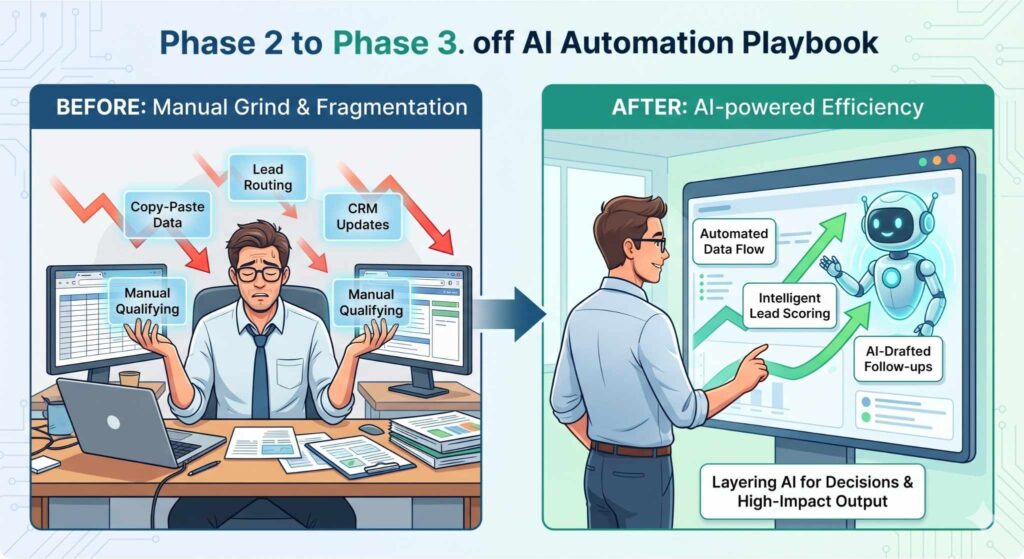
Phase 3 – Layer AI for decisions and unstructured data
Once the basics are automated, we introduce AI where judgment and unstructured data used to slow everything down.
Examples include reading inbound emails and classifying their intent, summarizing sales calls into CRM‑ready notes, or analyzing multi‑touch behavior across your site and content to detect buyer intent.
Well‑designed AI agents can reach around 90 percent accuracy in predicting which leads are likely to convert, beating traditional scoring models that hover around 60–70 percent.
This is where AI stops being “nice to have” and starts directly improving your close rate and sales team prioritization.
Phase 4 – Orchestrate autonomous agents with guardrails
Now we connect multiple AI agents into orchestrated flows.
For example, an outbound agent might research prospects, craft personalized messages, send them via your chosen channel, log everything in the CRM, and notify your team when a reply passes a qualification threshold.
To protect your brand and data, we build governance into the system: approval thresholds, strict prompts, permissioning, and clear logging so humans can see and override automation at any step.
The result is a semi‑autonomous revenue engine that feels like having a small operations team working 24/7 inside your stack.
Phase 5 – Scale, measure, and keep humans in the loop
Finally, we treat the system like a product, not a one‑off project.
We define key metrics for each automation (conversion rate, time‑to‑response, time‑to‑close, hours saved) and review them regularly to identify where to extend or refine.
Crucially, humans stay in the loop: your team gives feedback on edge cases, we refine prompts and rules, and we ensure that automation augments your best people rather than trying to replace them.
This is how you avoid the “set it and forget it” trap that kills most DIY automation experiments.
High‑Impact Use Cases: Where B2B Founders See ROI Fast
Lead generation and outbound outreach
Outbound used to mean armies of SDRs sending generic, low‑quality messages.
Now, with AI‑assisted research and copy, a single system can identify high‑intent prospects, draft context‑aware messages, and personalize at scale based on firmographic and behavioral data.
When combined with automation for sequencing and follow‑up, B2B teams are seeing more responses and higher quality conversations from the same or lower outreach volume.
Your cost per meeting drops, and you no longer need to keep scaling headcount just to maintain pipeline.
Lead qualification and appointment setting
One of the easiest wins is turning lead qualification into an automated, always‑on system.
AI agents can score leads in real time based on their activity, message content, and historical patterns, then either auto‑book them into calendars or route them to the right rep.
This cuts the delay between “I am interested” and “I am on a call with someone,” which is often the difference between closed‑won and ghosted.
It also removes the emotional labor and inconsistency of having different humans decide what a “good lead” looks like.
Proposals, onboarding, and client success
Post‑sale, the risk is that operational chaos destroys margins and client experience.
AI automation systems can generate draft proposals from discovery call notes, trigger onboarding sequences as soon as deals are marked won, and keep clients in the loop with smart updates and reminders.
In professional services and consulting businesses, these kinds of systems drive 160–280 percent two‑year ROI by freeing founders from low‑value delivery work and improving billable utilization.
Clients feel like they are working with a mature, organized firm rather than a founder juggling everything in their head.
The ROI of AI Automation Systems (With Real Numbers)
Payback periods and 2‑year ROI ranges
Let’s talk money instead of hype.
Cross‑industry analyses show that when B2B companies invest in the right automation projects, it is common to see payback inside 6–14 months and 2‑year ROI in the 160–400 percent range.
Typical patterns look like this.
- B2B SaaS (10–50M ARR): 6–10 month payback, 240–400 percent two‑year ROI, driven by revenue acceleration and cost savings.
- Professional services / consulting: 9–14 month payback, 160–280 percent two‑year ROI, driven by better use of billable hours.
- Executive search / recruiting: 8–12 month payback, 200–360 percent two‑year ROI, driven by faster placement cycles.
The core lesson: if you pick high‑volume, high‑variability processes (like sourcing, qualification, or unstructured data processing) you unlock disproportionate returns.
ROI self‑diagnosis table for your business
Use this simple table as a quick sanity‑check for where to star
| Area | Signs you are ready for automation | Typical ROI driver |
|---|---|---|
| Outbound lead gen | Reps copy‑pasting research, generic messages, low reply rates | More meetings with same or fewer SDRs |
| Inbound qualification | Leads sit in inbox/CRM for days, inconsistent follow‑up | Higher close rate from faster response |
| Client onboarding | Ad‑hoc onboarding, repetitive manual emails and checklists | Time saved per client, fewer churn events |
| Reporting and insights | Weekly manual reporting, Excel hell, data in multiple systems | Leadership clarity, better decisions |
If at least two of these rows describe your current situation, you are leaving serious money on the table.
Example: How a B2B Founder Bought Back 20 Hours per Week
The before picture: Slack chaos and spreadsheet hell
Imagine a 7‑figure B2B service business: inbound and outbound both working, but all the glue in between is manual.
The founder is in every sales thread, manually checking the CRM, nudging people in Slack, and updating spreadsheets at night just to keep a sense of control.
Leads go cold because nobody noticed they filled out a form, proposals sit unsent because notes are buried, and clients experience delayed onboarding.
The founder thinks “I need more people,” but in reality they need a system.
The after picture: one lead‑to‑cash system running on autopilot
Over a focused 14–30 day implementation, we would.
- Map every step from lead capture to invoice.
- Implement rule‑based automations to remove “status update” work.
- Deploy AI agents to qualify leads, summarize calls, and prepare proposal drafts.
- Orchestrate appointment setting and follow‑up with minimal human touch.
Within a few weeks, that founder can step back from day‑to‑day chasing and focus on strategy, partnerships, and high‑value client work — effectively buying back 15–20 hours per week without adding a single hire.
The system becomes an asset: something that makes the business easier to run, easier to sell, and more valuable, instead of harder to manage every time you grow.
How I Deploy This System for B2B Founders in 14 Days
What happens on the strategy call
On the strategy call, we are not talking about “AI in general” or generic best practices; we are dissecting your specific revenue engine.
We look at your current lead sources, sales process, delivery stack, and the places where you personally feel bottlenecked or constantly pulled back into operations.
From there, we outline a pragmatic 14‑day deployment plan focused on one or two high‑impact systems first, instead of boiling the ocean.
This call is also where we confirm tool choices, data constraints, and the governance model that fits your tolerance for automation.
What we build, and what stays in your control
During the engagement, I work with you to.
- Design and implement the automation backbone around your CRM and core tools.
- Deploy AI agents for lead research, qualification, and post‑call processing where appropriate.
- Build dashboards so you can see what the system is doing and what results you are getting.
You keep ownership of all tools, data, and workflows; my role is to design, build, and tune the system so your team can run it and extend it safely.
The outcome is not “we connected some tools,” it is “we built an AI‑powered lead‑to‑cash system that makes it easier to run and scale this business.”
Ready to Stop Patching With Headcount? Here is Your Next Step
If your default response to growth is “hire someone new,” you are scaling complexity, not profit.
AI automation systems for B2B founders flip the equation: you design a smarter system first, then decide where humans add the most leverage on top of that.
If you want that shift but do not want to become your own automation engineer, we should talk.
